Sales
Record cash and credit sales with the corresponding customer, revenue and tax accounting.
Complete books of accounts built around Indian accounting practices — with powerful voucher accounting, bill-wise receivables and payables, banking, GST, TDS, financial controls, audit trails and real-time financial reporting.
From the first voucher to the Balance Sheet, TEZ keeps every number accounted for, traceable and under control.
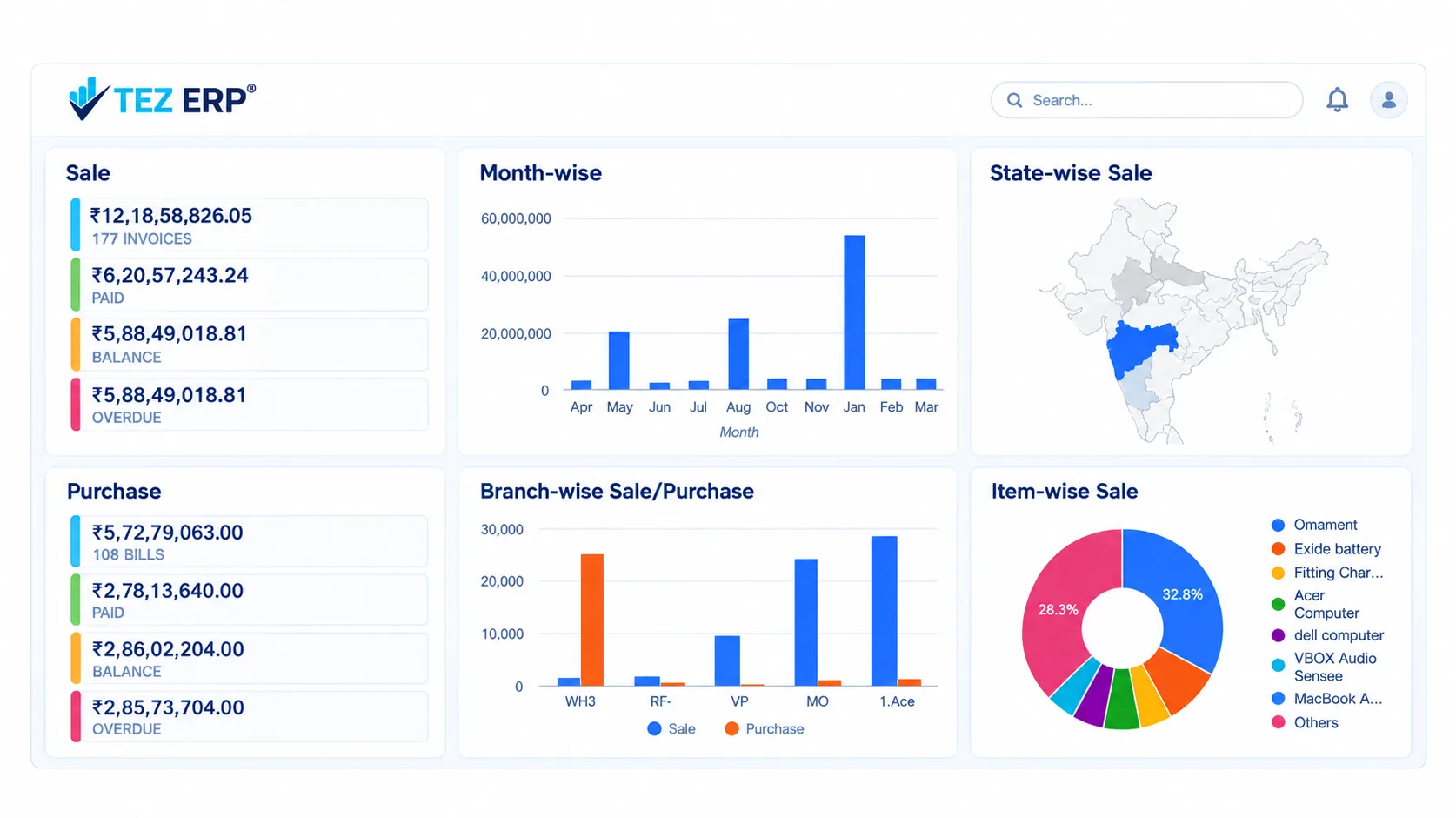
TEZ ERP gives your finance team a complete double-entry accounting environment for maintaining books accurately across companies, branches, departments and financial periods.
Build and maintain a structured Chart of Accounts with:
Your books remain structured around the way your organisation accounts and reports.
Record and control all principal accounting vouchers within one accounting system.
Record cash and credit sales with the corresponding customer, revenue and tax accounting.
Record cash and credit purchases with the corresponding vendor, expense or asset and tax accounting.
Account customer collections, advances, deposits and other receipts against the appropriate ledger and bill references.
Record vendor payments, expenses, advances and other disbursements with complete accounting references.
Manage transfers between cash and bank accounts and between bank accounts.
Pass adjustment, provision, accrual, transfer, rectification and other journal entries.
Maintain debit and credit adjustments with their corresponding ledger and bill-wise impact.
Account expenses with the appropriate ledger, party, cost centre, tax and supporting references.
Every accounting entry ultimately reaches the General Ledger.
TEZ gives accountants detailed ledger visibility with the ability to review transactions by account, period, voucher type, party, branch, department and other applicable accounting dimensions.
without losing the trail behind the number.
Because a financial report is only as useful as your ability to explain what created it.
TEZ supports bill-wise accounting for customers and vendors so receipts and payments can be tracked against the transactions they actually settle.
A customer may owe ₹10 lakh.
Accounting needs to know which invoices make up that ₹10 lakh.
TEZ keeps that answer available.
Receivables are more than a customer balance.
TEZ helps finance teams monitor collections at bill level with visibility into:
Analyse outstanding balances across ageing periods and drill down from the ageing figure to the customer, bill and underlying voucher.
Who owes us?
How much is overdue?
Which bills are pending?
How old is the outstanding?
What has already been received?
TEZ Accounting gives you the trail behind every answer.
Maintain bill-wise control over vendor liabilities, advances and settlements.
Understand what is:
Give finance a clear view of upcoming liabilities instead of discovering them only when a payment request arrives.
Maintain independent cash and bank ledgers with a complete record of:
Review cash transactions and balances for the selected period.
Review the complete accounting history of each bank account.
Know the accounting position of your bank accounts from within the books.
TEZ supports bank reconciliation so finance teams can identify and resolve differences between accounting records and bank activity.
Import bank statement information and reconcile accounting entries against actual banking activity.
Move directly from a reconciliation difference to the accounting transaction behind it.
Track applicable post-dated receipts and payments separately from current cleared transactions.
Maintain visibility over post-dated instruments and their expected realisation or payment dates without confusing them with completed banking activity.
Post-dated instruments stay in their own view until the dated day arrives, so cleared bank activity and future commitments are never read as the same thing.
What is still to come is visible without disturbing what has already settled.
TEZ applies GST accounting as part of the underlying transaction so tax reporting originates from properly accounted vouchers.
Review the accounting transactions behind GST values instead of treating compliance as a disconnected month-end exercise.
Maintain TDS-related accounting within the underlying financial transaction.
Keep the deduction connected to the voucher and party transaction from which it originated.
Maintain books for multiple companies while preserving the accounting identity of each entity.
Analyse the appropriate company without maintaining disconnected accounting installations.
Maintain branch-wise accounting while allowing authorised users to view the financial position at the level relevant to them.
Know where income was earned, where expenditure was incurred and which branch created the underlying transaction.
Allocate income and expenses to relevant accounting dimensions such as:
Analyse financial performance beyond the ledger and understand the areas of the organisation creating revenue or consuming cost.
Because knowing the total expense is only the beginning.
Create repeatable accounting patterns for recurring transactions such as:
Use defined templates and schedules to reduce repetitive accounting entry while maintaining appropriate accounting control.
Attach applicable supporting documents to accounting transactions so the financial entry and its evidence remain connected.
When finance or audit reviews a voucher, the supporting information should be available with the transaction—not buried in an email or physical file.
TEZ places control around sensitive financial activity through configurable user responsibilities and authorisations.
Control access by responsibility, including applicable restrictions around:
Route applicable financial transactions through defined authorisation levels before completion.
Financial transactions remain associated with the users and actions behind them.
TEZ retains transaction and user trails to strengthen accountability across the books.
Create a stronger accounting environment for internal review, management control and audit.
TEZ Accounting provides the reports finance teams work with every day.
Complete chronological view of accounting transactions.
Cash transactions and balances.
Bank-account-wise transaction history.
Accounting register of sales transactions.
Accounting register of purchase transactions.
Journal entries for the selected accounting period.
Complete debit note history.
Complete credit note history.
Review transactions by voucher type.
Filter and analyse accounting information for the required period and drill down to the transactions making up the balance.
Move from the total outstanding amount to the individual bill.
Review debit and credit balances across your Chart of Accounts and drill into the groups, ledgers and transactions behind them.
Use the Trial Balance to review the integrity and composition of your accounts before moving into final financial statements.
Balances are presented account by account for the selected period, and every figure opens into the accounting beneath it.
before the numbers become final financial statements.
View income and expenditure for the selected accounting period through a structured Profit & Loss Account.
to understand exactly what created the reported number.
Review assets, liabilities and the financial position of the organisation at the selected date.
Move from a Balance Sheet value through its accounting hierarchy down to the underlying transaction.
Assets and liabilities are reported for the chosen date, and each reported value stays connected to the accounting hierarchy that produced it.
so the position can always be explained, not just reported.
A number on the Balance Sheet should always have a trail behind it.
TEZ is designed around accounting drill-down.
Start with a financial statement.
Open the account group.
Review the ledger.
Identify the voucher.
Examine the underlying transaction.
No separate spreadsheet reconstruction.
No searching through disconnected reports.
No asking five people where a number came from.
Give authorised finance users and management immediate visibility into key accounting indicators such as:
Relevant dashboard values can link back to the detailed accounting information behind them.
Because a dashboard should not merely show a number.
It should let you understand it.
TEZ has been built around established Indian accounting practices and the accounting structures businesses use every day.
The concepts are familiar.
The control, accessibility and depth go further.
A serious accounting system must answer more than:
"Can I pass a voucher?"
It should also answer:
What does the customer owe?
Which invoices are overdue?
What do we owe vendors?
What remains unreconciled?
Which ledger created this P&L movement?
What vouchers make up this balance?
What changed in the books?
Who entered it?
What document supports it?
What is our GST position?
What is our current financial position?
That is the accounting standard TEZ is built to deliver.
Accounting should give your organisation confidence in every number—from the voucher entered today to the Balance Sheet reviewed at year-end.
Your books deserve more than basic accounting software.
Book a TEZ Accounting Demo